
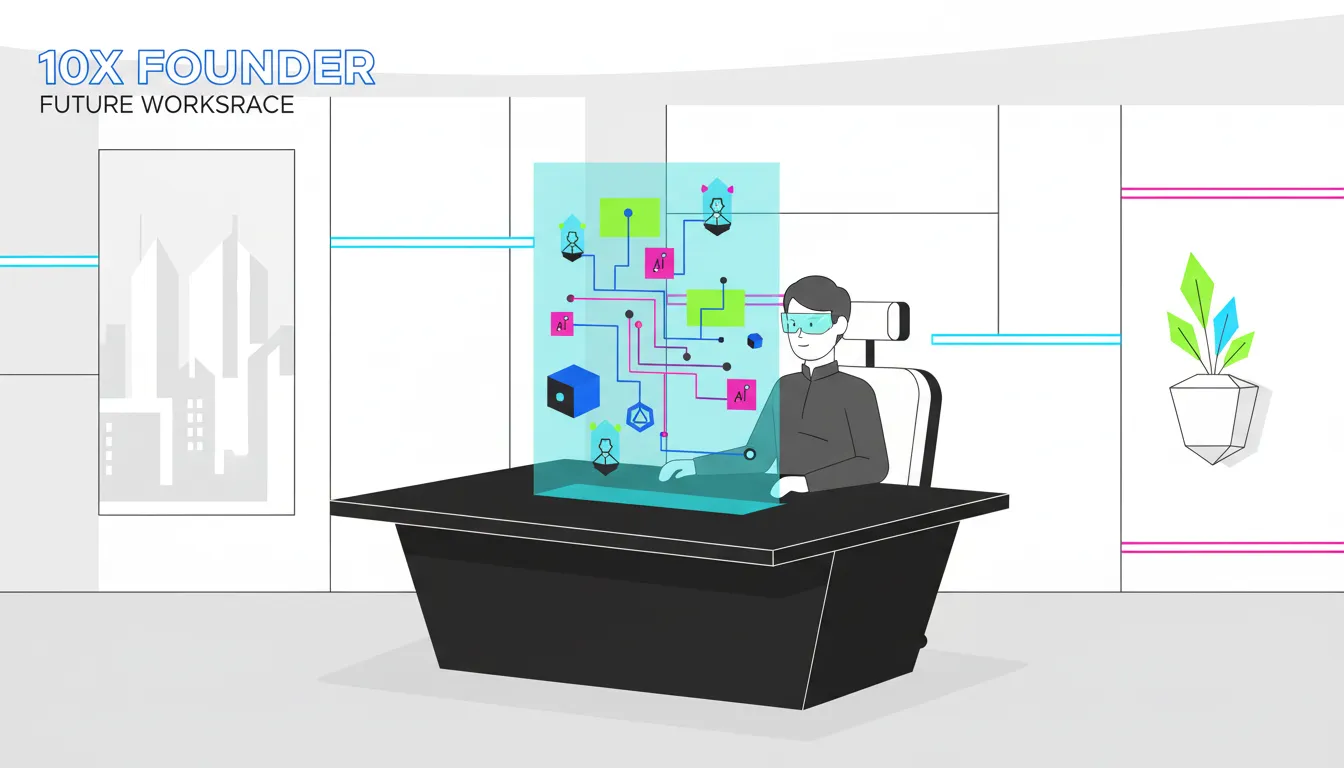
You're not writing code anymore. You're orchestrating systems. The AI-first development workflow 2026 isn't about autocomplete on steroids — it's a full agentic fabric where your IDE, your CI/CD pipeline, and your design tools talk to each other while you drink coffee and make actual decisions.
Here's the stack that separates 10x founders from people still arguing about tabs vs. spaces.
The 2026 Stack at a Glance
| Layer | Tool | Speed | Cost | Reliability | |---|---|---|---|---| | IDE | Cursor / Zed | ⚡⚡⚡ | $$ | High | | Coding Agent | Devin / OpenDevin | ⚡⚡ | $$$ | Medium-High | | UI Gen | v0.dev / Lovable.dev | ⚡⚡⚡ | $ | High | | CI/CD | GitHub Actions + AI agent | ⚡⚡ | $$ | High | | Model Routing | Custom MCP layer | ⚡⚡⚡ | $ | Very High |
"Copilot" is a legacy term now. It implies a passenger. What you want is an autonomous crew.
Your IDE Should Know Your Entire Codebase
AI-native IDEs like Cursor and Zed aren't just fancy text editors. In 2026, they use Model Context Protocols (MCPs) to ingest your full repo history, dependency graph, and past PR comments before generating a single line.
The latency difference matters for real-time pair programming:
- Claude 4: Best reasoning depth, slightly higher latency (~800ms)
- GPT-5: Fastest for boilerplate generation (~400ms)
- Gemini 2.0: Best for multimodal tasks (reading your Figma screenshots)
Pick based on the task, not brand loyalty. Smart teams route automatically.
Autonomous Coding Agents: Which One Won't Burn Your Repo?

The 2026 leaders are Devin, OpenDevin, and Sweep.dev. Here's the honest breakdown:
- Devin: Most capable for multi-file refactors, but expensive and occasionally overconfident
- OpenDevin: Open-source, highly customizable, better hallucination control with proper guardrails
- Sweep.dev: Best for scoped tasks like "fix this GitHub issue" — low blast radius
The real skill isn't picking an agent. It's setting agentic guardrails: execution limits, approval gates before production pushes, and sandboxed environments. Without these, you'll come back from lunch to a refactored auth system nobody asked for.
Quick setup for guardrails:
- Set max token execution limits per agent session
- Require human approval for any changes touching
/auth,/payments, or DB migrations - Run agents in a staging branch only; merge requires passing tests
One founder shipped a full-stack MVP in under 4 hours using OpenDevin with these exact constraints. The guardrails weren't slowing things down — they were the reason it worked.
Design to Code Without the Manual Export Nightmare
Figma exports are a 2024 problem. In 2026, v0.dev and Lovable.dev generate production-ready React/Next.js components directly from prompts or screenshots.
The workflow that actually works:
- Screenshot a competitor UI or your own wireframe
- Feed it to v0.dev with a prompt like "convert to Next.js with Tailwind, dark mode"
- Get 95%-accurate scaffold in under 60 seconds
- Push directly to your GitHub repo via the built-in integration
When you're moving between AI-generated design specs and actual frontend code, variable naming conventions become a real headache. A quick pass through a Case Converter saves you from the userName vs user_name vs UserName chaos that breaks component imports.
No manual export. No Zeplin. No "can you re-export that with 2x resolution" Slack messages.
Self-Healing CI/CD: Your Pipeline Should Fix Itself
According to 2026 industry data, 68% of QA teams now use AI for predictive regression testing — prioritizing which tests to run based on what changed, not running everything every time.
This setup uses agents to catch a failing test, reproduce it in a sandbox, and open a PR with the fix while you're still on your first cup of coffee. You approve or reject. You don't debug at 2am anymore (unless you want to, which, same).
One-click serverless deployment for Llama 4 and Mistral Large 3 is now standard on Replicate and Modal. No GPU provisioning required.
Agent-to-Agent Communication: The MCP Layer
Your PM agent writes a spec. Your Dev agent reads it. Your QA agent tests it. This is the A2A handshake and it runs on Model Context Protocols.
MCP standardizes how agents share context securely, with least-privilege access and full auditability. The practical win: intelligent model routing that sends simple tasks to cheaper models (Mistral) and complex reasoning to heavier ones (Claude 4). Teams report 30-50% reductions in inference costs using this approach (orchestration platform data, 2026).
When agents spit out JSON, validate it immediately. Trust, but verify (and then verify again). The JSON Formatter & Validator is the fastest free way to catch malformed agent responses before they silently corrupt your data pipeline.
Is This Stack Worth the $500/Month?
Use the ROI Calculator before your next budget meeting. Plug in your current dev hourly rate, hours spent on boilerplate, testing, and bug fixing — the math usually makes the "expensive" AI subscription look cheap.
Rough comparison:
| Metric | 2024 Legacy Workflow | 2026 AI-First | |---|---|---| | MVP time | 6-8 weeks | 1-2 weeks | | Bug fix cycle | 2-3 days | 4-6 hours | | Design-to-code | Manual, 1-2 days | Automated, 1 hour |
Audit Your Workflow Today
The 2026 10x stack: AI-native IDE, agents with actual boundaries, design-to-code, and a CI/CD pipeline that fixes its own messes.
Human-in-the-loop is non-negotiable for payment logic, auth systems, and anything with legal exposure. Automate the scaffolding; own the decisions.
Your homework: find the 'AI-blind spots' in your workflow—the manual chores an agent could do while you sleep. You probably have three. Fix them.
Frequently Asked Questions
Q: Which AI agent won't accidentally delete my production database? OpenDevin with proper guardrails configured produces the most consistent results for most teams, especially on scoped tasks. Devin handles complex multi-file work better but requires stricter approval gates to prevent scope creep.
Q: How do I skip the 'Figma to Code' manual labor nightmare? Use v0.dev or Lovable.dev with their GitHub integration enabled. Screenshot or prompt your design, generate the React/Next.js component, and push directly to a feature branch — no Figma export step required.
Q: What are the best free, no-signup AI tools for quick data visualization and profit calculation? The ROI Calculator handles financial modeling instantly. For structured data debugging from AI outputs, the JSON Formatter & Validator requires zero signup and works immediately.
Q: How do I get my CI/CD to stop screaming and start fixing itself? Connect an AI agent (OpenDevin or Sweep.dev) to your GitHub Actions workflow with a sandboxed staging environment. Configure it to reproduce failing tests, generate fix PRs, and require human approval before any merge to main.
Q: Which models are fast enough to keep up with my 3am coding sessions? GPT-5 leads for raw speed on boilerplate tasks (~400ms). Claude 4 wins on reasoning quality for complex refactors. Use an MCP routing layer to get both without paying for one model to do everything.